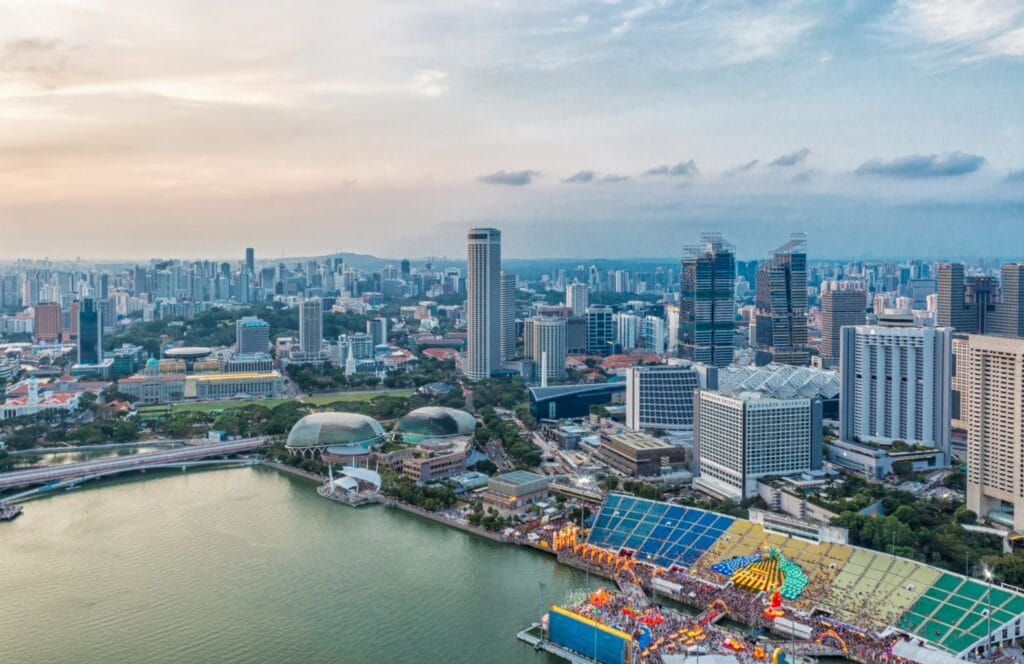
Singapore’s private banking sector managing over $2 trillion in assets isn’t an accident — it’s the result of twenty years of deliberate policy, regulatory design, and geographic luck. As of 2025, no other city-state on the planet competes with Singapore’s ability to attract ultra-high-net-worth families, single-family offices, and global wealth management firms under one roof. The 2024 league table confirmed a record-breaking year for Singapore private banks AUM, with Asia’s top 10 institutions posting their second consecutive year of expansion and collectively breaking the $2 trillion barrier for the first time.
What changed in 2025? A lot. Bank of Singapore
AUM is a size metric, not a suitability metric. For a working assessment of how DBS, UOB, and Bank of Singapore compare for non-resident foreign clients — scored on RM continuity, compliance posture, and investment depth — the dedicated scorecard covers what the league table cannot.
quietly hit its $145 billion target ahead of schedule. DBS launched a multi-family office platform that already manages over SGD 1 billion just two years in. J.P. Morgan — already the fastest-growing major bank in the 2024 data — kept hiring aggressively. And meanwhile, Singapore’s family office count pushed well past 1,100 single-family offices, cementing the city as Asia’s undisputed wealth structuring capital.The rankings below draw on the latest verified data from finews.asia’s 2024 AUM League Table, Asian Private Banker’s 2025 insights, and direct bank disclosures. Where 2025 updates are available, they are included. Where they aren’t, 2024 figures are the most accurate available benchmark.
2024–2025 Singapore Private Banks AUM: The Full League Table
The table below ranks the ten leading private banks active in Singapore by their Asia-Pacific AUM, using the 2024 finews.asia league table as the primary source and supplemented by 2025 disclosures where available. Note that most institutions book assets across both Singapore and Hong Kong; the figures represent Asia-wide AUM attributed to institutions with a significant Singapore booking centre.
| Rank | Bank | Asia AUM (2024) | YoY Change | Key 2025 Update | Min. Entry (Singapore) |
|---|---|---|---|---|---|
| 1 | UBS Global Wealth Management | $665B | +3.1% | Credit Suisse integration complete; dual co-head structure in APAC | SGD 2M+ |
| 2 | HSBC Global Private Banking | ~$354B | +$42B added | Asia now 51.9% of global AUM; record wealth income in 2025 | SGD 2M+ |
| 3 | DBS Private Bank | ~$215B | High single digit | MFO Foundry VCC surpassed SGD 1B; Best Private Bank SG 2025 (Euromoney) | SGD 1.5M (Treasures PC) |
| 4 | J.P. Morgan Private Bank | $215B | +29.5% | Best Private Bank SG for UHNW (APB Awards 2024); continued hiring push | ~USD 10M (UHNW focus) |
| 5 | Morgan Stanley Private Wealth Mgmt | $175B | +15.1% | Expanding ASEAN coverage and alternatives access | USD 5M+ |
| 6 | Julius Baer | $173B | +23.6% | Strong rebound after 2022 dip; new CEO Stefan Bollinger first trip to Asia | SGD 2M+ |
| 7 | Bank of Singapore (OCBC) | ~$125B (2024) → $145B (Q3 2025) | +~20% since early 2023 | Exceeded $145B target; HK AUM surpassed 50% growth target ahead of schedule | USD 5M |
| 8 | Goldman Sachs Private Wealth Mgmt | $122B | +22% | UHNW-only focus ($100M+ threshold); 30% Asia expansion over 3 years | USD 100M (UHNW) |
| 9 | LGT Private Banking | ~$80B (APAC est.) | Steady | Liechtenstein royal family ownership; growing ASEAN boutique presence | SGD 2M+ |
| 10 | UOB Private Wealth | ~S$176B | Growing | Targets to double AUM; Citi ASEAN acquisition opens new client pipeline | SGD 2M (Privilege Reserve) |
Sources: finews.asia 2024 Private Banking AUM League Table; Asian Private Banker 2025; individual bank disclosures. AUM figures represent Asia-Pacific scope unless otherwise noted. Some figures are estimates where banks do not publicly disclose regional breakdowns.
Visualising the AUM Gap: Who Leads and by How Much
The chart below makes one thing immediately obvious: UBS’s lead is enormous. Its $665 billion Asia AUM is nearly double HSBC’s position and more than three times J.P. Morgan’s $215 billion. That gap is partly a legacy of the Credit Suisse absorption, which added hundreds of billions overnight. However, it’s also a function of UBS’s depth in the ultra-wealthy segment — clients with over $50 million — where relationships are stickier and asset migration is rare.
What the chart doesn’t show is momentum. Goldman Sachs grew 22 percent in a single year. Julius Baer bounced back 23.6 percent after a turbulent 2022. Bank of Singapore grew nearly 20 percent from early 2023 to Q3 2025. Size at a single point in time tells you who’s winning today; growth rate tells you who is building tomorrow’s position.
Why American Banks Outgrew Everyone Else in 2024
J.P. Morgan’s 29.5 percent AUM surge — adding $49 billion in a single year — wasn’t magic. It was a direct reflection of what their clients held. Asian private banking clients allocate heavily to US equities. The S&P 500 returned 25 percent in 2024, and the so-called Magnificent Seven (Apple, Nvidia, Microsoft, Alphabet, Amazon, Meta, Tesla) averaged gains of over 60 percent. Clients heavily exposed to US tech through J.P. Morgan’s platforms saw their portfolios swell dramatically, boosting reported AUM without requiring a single new client.
Morgan Stanley (+15.1%) and Goldman Sachs (+22%) tell the same story. All three American banks benefited from client portfolios tilted toward markets that massively outperformed. However, J.P. Morgan also ran an aggressive hiring campaign across Singapore, bringing in Chris Harwood from HSBC as market head for Indonesia and Southeast Asia — a signal that organic new money inflows, not just market gains, are part of the story.
What most analyses miss: J.P. Morgan’s 2024 growth was simultaneously a market-performance story and a talent-acquisition story. The bank’s willingness to publicly announce new hires on LinkedIn — unusual in private banking’s traditionally discreet culture — signals a deliberate strategy to signal momentum and attract clients who follow relationship managers.
Julius Baer’s 23.6 percent rebound deserves its own paragraph. After dropping 15.1 percent in 2022 and barely growing in 2023, Julius Baer brought in $33 billion of new AUM in 2024, driven by $16.5 billion in net new money inflows. New group CEO Stefan Bollinger chose Asia as his first overseas destination after taking the top job in January 2025 — a clear message about where the bank sees its growth runway.
Singapore’s Local Champions: DBS, Bank of Singapore, and UOB
Global private banking rankings often bury the most interesting story: Singapore’s home-grown institutions are closing the gap on international giants, and in several specific segments, they’ve already overtaken them.
DBS is the most compelling example. The bank won Euromoney’s Best Private Bank Singapore and Asia’s Best Private Bank for 2025. Joseph Poon, group head of DBS Private Bank, won Asian Private Banker’s Private Banker of the Year award in 2024. DBS now serves over one-third of Singapore’s 1,100+ single-family offices — a market-share figure that no foreign competitor has come close to replicating. Furthermore, the DBS Multi-Family Office Foundry VCC platform, launched just two years ago, already manages over SGD 1 billion in assets from over 25 families across Europe, India, Greater China, and Southeast Asia. The platform aims to double that to SGD 2 billion by end-2026.
Bank of Singapore’s trajectory is arguably the most impressive in absolute terms. CEO Jason Moo set a target of $145 billion in AUM and 500 relationship managers by end-2025. As of Q3 2025, the bank had already surpassed both targets. UHNW assets grew nearly 20 percent in the first three quarters of 2025 alone. The Hong Kong office — its largest outside Singapore — exceeded its own target of 50 percent AUM growth between 2024 and 2026, ahead of schedule. Dubai is next: the bank ranks third among private banks there and aims for the city to represent 20 percent of AUM by 2027.
For context on Bank of Singapore’s investment performance: as of June 2025, its Asia equity portfolio had delivered a 14.2 percent year-to-date return, and its Singapore equity portfolio a 12.6 percent gain. Over five years, the Singapore portfolio compounded at 12.7 percent annually — comfortably ahead of reference indices. Those are numbers a portfolio manager at any global firm would be proud to post.
UOB Private Wealth, meanwhile, is playing a longer game. The Citi ASEAN acquisition — absorbing Citi’s consumer banking operations across Indonesia, Malaysia, Thailand, and Vietnam — handed UOB a client pipeline of hundreds of thousands of affluent customers who can be migrated toward private banking services over time. The bank’s stated ambition is to double its S$176 billion wealth AUM, and that acquisition is the mechanism.
2024 AUM Growth Rates: Who Moved Fastest
Growth rate is the metric that separates institutions genuinely gaining market share from those merely benefiting from rising markets. The bars below show year-on-year AUM growth for the major institutions in 2024. Bars above 13 percent — the sector average — indicate market share gain; below 13 percent means the bank grew slower than its peers.
UBS’s 3.1 percent growth deserves a word of context. When you manage $665 billion, adding 3.1 percent means finding $20 billion in new or appreciating assets — not a trivial task. The bank is also still digesting the Credit Suisse integration, which created internal complexity around client retention and relationship manager alignment. The real test for UBS will be whether 2025 and 2026 growth accelerates now that integration overhead is largely behind them.
How Singapore Private Banking Actually Works: Minimums, Models, and What to Expect
There’s persistent confusion in the market about what “private banking” means versus “priority banking.” The two are not the same, and conflating them leads to disappointment.
Priority banking (DBS Treasures, HSBC Premier, UOB Privilege) starts at SGD 100,000–350,000. At that level, you get a relationship manager, some preferential rates, and airport lounge access. Genuine private banking — with a dedicated advisor, discretionary portfolio management, access to alternatives, and family office-grade structuring — starts considerably higher. Here’s how the real thresholds break down:
| Bank | Minimum AUM for Private Banking | Primary Client Focus | Notes |
|---|---|---|---|
| DBS Treasures Private Client | S$1.5M (~USD 1.1M) | Singapore/ASEAN HNW | Local ecosystem; strong digital; family office services from SGD 15M |
| HSBC Global Private Banking | S$2M+ (~USD 1.5M) | Globally mobile families | Cross-border lending, multi-booking centres |
| UOB Privilege Reserve | S$2M (~USD 1.5M) | Southeast Asia HNW | Strong ASEAN network post-Citi acquisition |
| Julius Baer | S$2M+ (~USD 1.5M) | International HNW/UHNW | Pure-play; no retail cross-sell |
| UBS Global Wealth Management | S$2M+ (~USD 1.5M) | UHNW/family offices | Global platform; best for internationally diversified wealth |
| LGT Private Banking | S$2M+ (~USD 1.5M) | International HNW | Liechtenstein royal family ownership; very low key; strong values-aligned investing |
| Bank of Singapore | USD 5M | UHNW/ASEAN/Greater China | Full investment capabilities in both Singapore and Hong Kong booking centres |
| J.P. Morgan Private Bank | ~USD 10M | UHNW/family offices | Skews heavily toward UHNW; strong US market access |
| Morgan Stanley PWM | USD 5M+ | UHNW | Strong alternatives and structured products capability |
| Goldman Sachs PWM | USD 100M | Ultra-UHNW only | Not accessible for most HNWIs; minimum is real, not aspirational |
One thing practitioners rarely mention: several Singapore private banks offer operational accounts only in specific circumstances. This is worth clarifying early in any discussion with a bank. If you need an account that handles business transactions alongside personal wealth management, not all institutions will accommodate that — Bank of Singapore, for instance, does not offer operational accounts.
If you’re exploring how to access Singapore private banking as a non-resident, working with an experienced intermediary significantly improves the process. The due diligence banks perform on international clients is thorough, and having documentation prepared correctly from the start avoids delays of weeks or months. You can explore the process for opening a Singapore bank account as a non-resident in detail, including what documentation is required at each institution.
The Family Office Effect: Why Singapore’s AUM Story Is Just Beginning
The most structurally important development in Singapore private banking isn’t captured in any single AUM figure. It’s the family office explosion. Singapore now hosts over 1,100 single-family offices — up from just 400 in 2020 — and that number continues to grow despite tightened MAS requirements around actual substance and employment thresholds introduced in late 2023.
Why does this matter for AUM? Family offices typically consolidate assets across one or two banking relationships rather than spreading them widely. A family with $200 million in assets that sets up a Singapore SFO will likely move the majority of those assets into Singapore-booked accounts. That’s new AUM that wasn’t there before — and it’s sticky. Families don’t relocate their offices every three years the way a portfolio manager might switch platforms.
DBS’s family office position is genuinely remarkable. The bank serves more than one-third of Singapore’s single-family offices and saw its family office AUM more than double over two years. For a domestic institution competing against global giants with centuries of heritage in private banking, that market penetration is extraordinary.
For those considering Singapore as a private banking jurisdiction, the family office context matters because it shapes the quality of the ecosystem. A city with 1,100+ family offices means a deeper talent pool of private bankers, better infrastructure for complex wealth structures, and more sophisticated product providers. The rising tide really does lift all boats here.
Moreover, Singapore’s Variable Capital Company (VCC) structure — introduced in 2020 — has given family offices a flexible, Singapore-domiciled fund vehicle that can onboard in as little as one month. DBS, Bank of Singapore, and several other banks now offer managed VCC solutions as part of their private banking proposition, allowing UHNW clients to access institutional-grade structuring without the full overhead of building a standalone single-family office. Those considering this route can discuss options through a direct consultation.
HSBC’s Asia Swing: What 51.9% Really Means
When HSBC Global Private Banking reported that Asia now represents 51.9 percent of its global private banking AUM — up from 46.8 percent just a year earlier — most headlines treated it as a data point. It’s actually a strategic watershed. For the first time, the majority of HSBC’s private banking assets sit in Asia, not in its traditional European and UK home markets.
Asia head Lok Yim called 2024 “a year of productivity and optimization” — which is banker-speak for: we didn’t just grow through markets, we actively brought in new money. Of the $42 billion added, $18 billion came from net new invested assets. Onshore businesses in mainland China, Taiwan, and India contributed, alongside the offshore booking centres in Hong Kong and Singapore.
For Singapore specifically, HSBC’s cross-border proposition is hard to match. The bank operates in 62 countries and provides genuinely integrated multi-booking functionality. Families with assets, businesses, and residences across multiple continents — a common profile among the internationally mobile clients Singapore attracts — benefit from a bank that can manage all of it within a single relationship structure.
What 2025 and Beyond Actually Looks Like
The 2025 picture that’s emerging from early disclosures is strong. Singapore’s three largest domestic banks — DBS, OCBC (through Bank of Singapore), and to a lesser extent UOB — all broke wealth fee and AUM records in 2025 according to Asian Private Banker. Standard Chartered’s Singapore wealth business also delivered record wealth solutions income. UBS continued its recovery trajectory.
Several structural tailwinds make this sustainable rather than cyclical. First, Asia-Pacific HNWI wealth grew 4.8 percent in 2024 according to Capgemini’s World Wealth Report — second only to North America — while the HNWI population itself expanded 2.7 percent. The client base is simply getting larger. Second, intergenerational wealth transfers are accelerating across Chinese, Indian, and Southeast Asian family businesses, creating natural trigger points for private banking engagement. Third, Singapore’s regulatory environment remains the most attractive in Asia for family office structuring, with MAS continuing to refine its frameworks rather than restrict them.
The tricky part for 2026 is geopolitical uncertainty. Tariff volatility, US-China tensions, and potential shifts in regional capital flows all create risks that could dampen new money inflows even if market performance stays strong. However, in practice, Singapore has tended to benefit from uncertainty elsewhere — when capital becomes nervous in Hong Kong, Mainland China, or other jurisdictions, it often flows toward Singapore. That dynamic has been a persistent tailwind for over a decade.
For non-residents looking to position assets in Singapore, the window remains excellent. Those interested in relocating to Singapore as an HNWI or simply establishing a private banking relationship without relocating should note that documentation requirements have tightened since 2022, but the underlying welcome for international capital remains genuine.
Frequently Asked Questions
UBS Global Wealth Management holds the #1 position with approximately $665 billion in Asia-wide AUM as of 2024 — a figure boosted significantly by the absorption of Credit Suisse’s operations in 2023. No other institution is close to that scale in the region. Among pure Singapore-headquartered banks, DBS Private Bank leads with around $215 billion in wealth management AUM.
The practical minimum depends on the bank. DBS Treasures Private Client starts at SGD 1.5 million (~USD 1.1 million). Most international banks (HSBC, Julius Baer, UBS, LGT, UOB) require SGD 2 million or above. Bank of Singapore and Morgan Stanley require around USD 5 million. J.P. Morgan skews toward USD 10 million and above. Goldman Sachs only accepts clients with USD 100 million or more. Importantly, SGD 200,000–350,000 figures you may see online refer to Priority Banking — not genuine private banking relationships with discretionary management and dedicated advisors.
Yes — and Singapore is specifically designed for international clients. Non-residents are welcomed by all major private banks, including UBS, HSBC, Julius Baer, DBS, and Bank of Singapore. However, due diligence requirements are rigorous. Banks will review your source of funds, source of wealth, nationality, country of residence, and purpose of account. Having proper documentation — typically including proof of identity, source of wealth documentation, and a clear account purpose narrative — prepared in advance makes a significant difference. Working with a specialist who understands each bank’s current risk appetite for specific nationalities and client profiles saves time considerably.
Switzerland and Singapore serve partly overlapping but distinct purposes. Switzerland remains the gold standard for European-facing wealth management, deep discretion, and multigenerational estate planning — particularly for clients with European residency, assets, or family connections. Singapore excels for Asia-Pacific market access, family office structuring via the VCC framework, and serving clients with wealth sourced from Chinese, Indian, Indonesian, or ASEAN business activities. Many UHNW families use both — holding separate booking relationships in each jurisdiction for different purposes. Maintaining accounts in both hubs is legal, common, and advisable for those with truly international wealth profiles. You can open a Swiss bank account remotely alongside a Singapore relationship.
Three factors drove the 13 percent sector-wide AUM growth in 2024. First, investment returns: the S&P 500 gained 25 percent and tech-heavy portfolios performed even better, mechanically inflating AUM without requiring new deposits. Second, net new money inflows from across Asia-Pacific, particularly from Greater China, India, and ASEAN, as wealth creation in those markets accelerated. Third, Singapore’s family office boom added structurally new AUM as families consolidated assets locally. In 2025, early data suggests momentum has continued, with DBS and Bank of Singapore both reporting record wealth results and UBS maintaining its recovery trajectory post-Credit Suisse integration.
Bank of Singapore has earned its reputation through performance. Its Asia equity portfolio returned 14.2 percent year-to-date as of June 2025, and the five-year annualised return on the Singapore equity portfolio sits at 12.7 percent — ahead of reference indices. The bank is unique among Singapore institutions in offering full investment capabilities in both its Singapore and Hong Kong booking centres. Its UHNW assets grew nearly 20 percent in the first three quarters of 2025, suggesting genuine client demand rather than just market appreciation. The $5 million minimum is a real barrier, but for clients who qualify, the combination of OCBC’s balance sheet backing and the bank’s investment management track record is compelling.
Choosing the Right Private Bank in Singapore
The right Singapore private bank depends almost entirely on three things: where your wealth is located, where you want to invest, and what you need beyond portfolio management. There is no universally “best” choice — the answer is different for a Hong Kong-based entrepreneur building a family office than for a European professional consolidating international assets, and different again for an ASEAN business owner looking to hedge geographic concentration.
UBS and Julius Baer are the natural starting points for anyone with genuinely international wealth and a preference for Swiss heritage alongside Asian market access. DBS and Bank of Singapore make strong cases for clients with significant Singapore ties or a desire for deep ASEAN connectivity. HSBC is uniquely suited to families with cross-continental footprints. J.P. Morgan and Goldman Sachs are difficult to beat for those with the required minimums and a strong US portfolio orientation.
For those navigating this landscape for the first time, the practical reality is that the onboarding process — KYC documentation, source of wealth declarations, risk profiling — is the biggest friction point, not the investment thesis. Understanding what KYC actually involves before you begin the process saves weeks of back-and-forth. The banks themselves want to onboard qualifying clients; the process just requires getting the paperwork architecture right from the start.
References
- finews.asia 2024 Private Banking AUM League Table — Asia Top 10 Record High
- Hubbis: Bank of Singapore Targets Asia’s Top Five Private Banks with USD 145 Billion AUM (2026)
- Asian Private Banker: Top 5 Private Banks in Singapore 2025
- Hubbis: DBS Private Bank Multi-Family Office Platform Hits USD 780 Million AUM (2026)
- Global Finance Magazine: World’s Best Private Banks 2025 — Asia-Pacific