By Asel Mamytova — international banking and wealth management specialist, 10+ years advising non-resident clients on Swiss and Singaporean banking. Last reviewed: 18 October 2026.
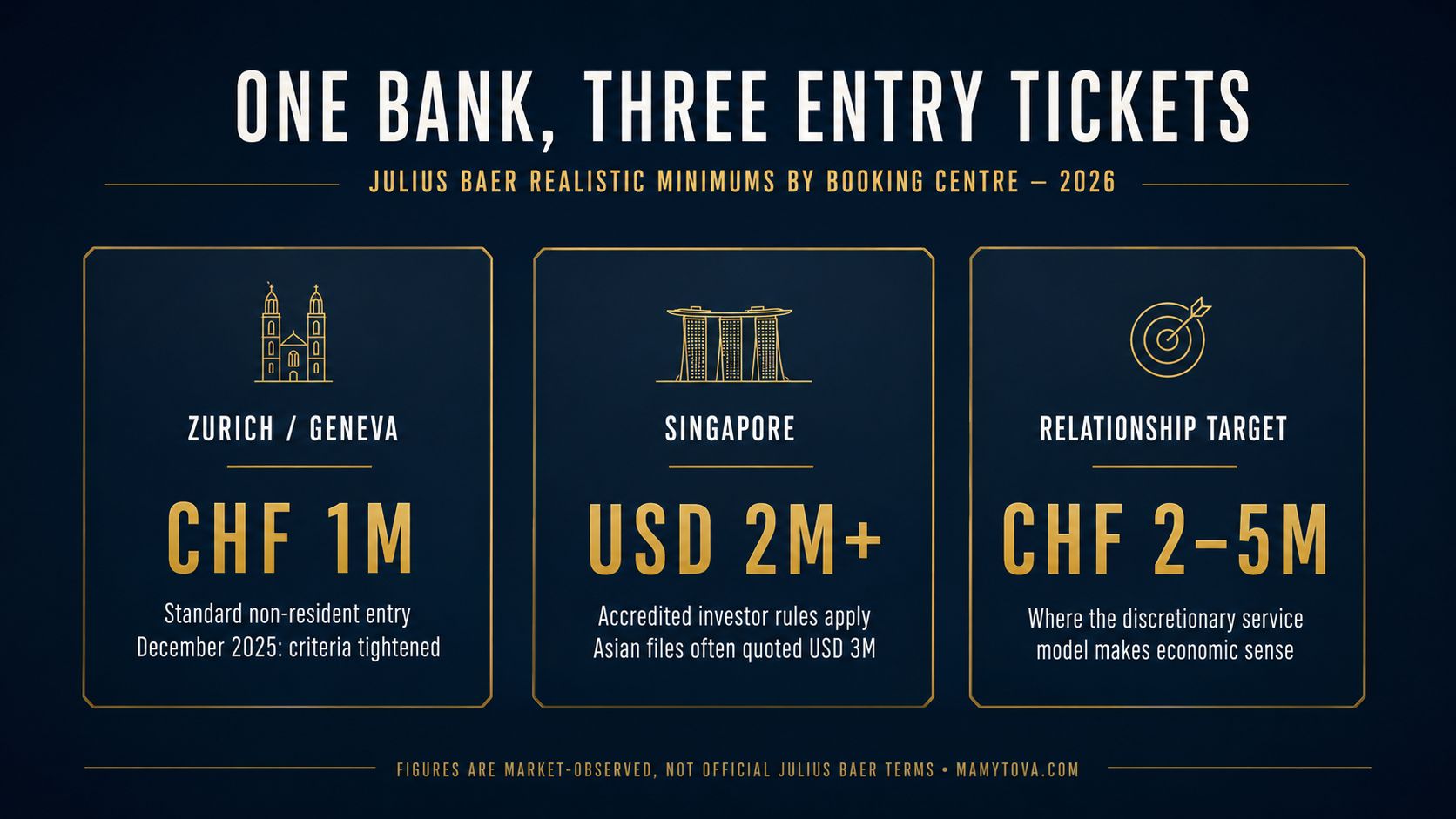
The Julius Baer minimum deposit is not published anywhere — not on the bank’s website, not in its 40-page schedule of prices and services, not in any brochure a relationship manager will hand you. In practice, the realistic entry point in 2026 is CHF 1 million for a non-resident booking in Zurich or Geneva, and USD 2 million or more for an account booked in Singapore. Below those levels, the conversation rarely starts.
Those figures come with an asterisk, and the asterisk is where most guides stop being useful. Julius Baer is a relationship bank in the middle of a deliberate risk reset — one triggered by the most expensive lending mistake in its recent history. Understanding that reset tells you more about whether your file will be accepted than any single number does. That’s what this analysis covers.
Figures throughout assume a typical Western European client with a clean profile. Higher-risk clients and clients from high-risk countries can face materially higher minimums — or refusal.
What Changed in December 2025 — and Why the Number Moved
Until late 2025, we routinely saw non-resident files open at Julius Baer with CHF 800,000–900,000 when the profile was clean and the growth story credible. That door has narrowed. In December 2025 the bank tightened its client acceptance criteria, and since then the CHF 1 million line has been enforced with far less flexibility — several files we tracked in the first quarter of 2026 were asked to commit CHF 1.5–3 million before onboarding would proceed.
Why the hardening? Two reasons, and only one of them is about money. First, 2025 was a record year — CHF 521 billion under management gives a bank very little incentive to stretch for marginal clients. Second, and more importantly, the compliance organisation that signs off on new relationships has been rebuilt from the top since the Signa affair (more on that below). New compliance leadership, installed after a public loss, does not begin its tenure by waving through borderline files. We’ve watched this cycle at other banks; it typically takes two to three years to loosen.
Practical takeaway: if your liquid assets sit at exactly CHF 1 million, 2026 is a harder year to approach Julius Baer than 2024 was. Either bring a stronger file, or read the sequencing section further down before you spend a compliance inquiry on a coin-flip.
Julius Baer Minimum Deposit by Booking Centre
Where your account is booked matters more than which Julius Baer office you first talk to. A client introduced through Dubai can still be booked in Zurich; an Indonesian family talking to a Zurich RM will usually end up on the Singapore platform. Each booking centre carries its own threshold, driven by local regulation and the economics of the platform.
| Booking centre | Realistic minimum | What drives it |
|---|---|---|
| Switzerland (Zurich / Geneva) | CHF 1–3 million | Standard non-resident entry; tightened December 2025 |
| Singapore | USD 2 million+ | MAS accredited investor rules plus platform economics; Asian-market files often quoted USD 3 million |
| “Comfortable” relationship size | CHF 2–5 million | Where the discretionary service model earns its fees — and where you stop being a marginal client |
A quick note on Singapore, because the higher threshold confuses people. It isn’t Julius Baer being difficult. Singapore’s accredited investor regime and the cost structure of the Asian booking platform push every major private bank’s local minimum above its Swiss equivalent — we see the identical pattern at UBS and Pictet. If you’re weighing the two jurisdictions against each other, our Swiss vs Singapore banking comparison goes through the trade-offs properly. Every figure here assumes a typical Western European client profile; higher-risk nationalities should expect materially higher thresholds.
Why Julius Baer Won’t Publish a Minimum
Julius Baer is a pure-play wealth manager — the largest in Switzerland without a retail arm. There is no mass-market business to absorb small accounts, so every relationship must justify its own compliance and servicing cost. That makes onboarding discretionary from the first phone call, and it makes a published minimum commercially useless to the bank: a fixed number would invite exactly the marginal applications it wants to filter out.
Relationship managers hold real latitude within that structure. A 45-year-old founder wiring CHF 900,000 with a company sale closing next year reads completely differently from a retiree wiring the same amount with no inflows ahead. We have seen the first profile accepted below the formal line and the second declined well above it — same amount, opposite outcomes. What the bank is actually underwriting is the trajectory of the relationship, not the opening balance.
Our honest advice: if you need a bank that publishes its entry ticket, Julius Baer is the wrong bank. The opacity isn’t an oversight — it is a screening mechanism, and how you navigate it is itself part of the assessment.
The Signa Aftermath: Inside the Risk Reset That Set Today’s Bar
You cannot understand the 2026 minimum without understanding what happened to this bank between 2023 and 2025. In late 2023, the collapse of René Benko’s Signa property group exposed Julius Baer to losses that reached CHF 606 million in net credit losses for the 2023 financial year. The CEO stepped down. The entire private-debt business — the unit that made the loans — was shut, with the loan book being wound down through end-2026.
In February 2025, Stefan Bollinger — a former Goldman Sachs partner — took over as CEO with an explicit mandate: simplify the bank and rebuild its risk culture. A new chief compliance role was added to the executive board. Clients, notably, did not leave; deposits stayed stable through the storm, and by 30 June 2026 assets under management had reached an all-time high of CHF 547 billion.
Here’s why this history matters to your application. A bank that has just paid CHF 606 million for a concentration of risk does not price risk the way it did before. The onboarding questions get longer. Source-of-wealth files that would have passed in 2022 come back with follow-up requests. And the unofficial flexibility at the bottom of the client book — the CHF 800K exceptions — is the first thing to disappear, because marginal clients are precisely where compliance cost exceeds revenue. The December 2025 tightening wasn’t a surprise to anyone watching the sequence. It was the last step of it.
There’s a silver lining, and it’s real: a Julius Baer account opened in 2026 sits inside one of the most conservatively risk-managed private banks in Switzerland — CET1 capital well above regulatory floors, the problematic lending business gone, and a compliance function nobody inside the bank dares to override. If you clear the bar, you’re in a stronger institution than the one that set a lower bar three years ago.
How the Julius Baer Minimum Compares With Other Swiss Private Banks
Seen against its peer group, Julius Baer’s threshold is exactly where its tier says it should be. The comparison below uses the figures we observe in practice for non-resident clients — the same numbers we use in our full guide to Swiss private bank minimum deposits.
Two things stand out. First, Julius Baer’s real peer on entry price is Vontobel — not the elite houses. Pictet and Lombard Odier sit a full tier above at CHF 5 million and up, so “Julius Baer or Pictet” is rarely a genuine choice at these asset levels. Second, the gap down to the boutiques is wide enough that stretching rarely makes sense. An applicant with CHF 600,000 sits below the line at Julius Baer but is a welcome client at Banque Heritage or Cramer & Cie, and the difference in day-to-day treatment is larger than the difference in the logo on your statements.
One critical caveat on every figure above. These minimums describe a typical Western European client with a clean, well-documented profile — a baseline, not a rule. For higher-risk clients, and for those holding passports or residence in countries the bank rates as high-risk, the entry threshold can be dramatically higher — sometimes several times the headline number — and in some cases the relationship is declined at any deposit size. Nationality and source-of-wealth risk move the bar far more than the published tier ever will.
What You Actually Get at CHF 1 Million
Honest answer: less than the brand suggests. At the entry level you are a small client at a large bank, and the service model reflects it. Your relationship manager will be competent — Julius Baer does not employ bad RMs — but you will share that RM with sixty to eighty other relationships, and the ones holding CHF 10 million call first. Expect an annual review, decent execution, access to the research platform, and polite but unhurried responses in between.
What you do get, and what genuinely differentiates the bank at this level, is the platform itself. Multi-currency accounts and Lombard lending against your portfolio are standard. The open product architecture is real — Julius Baer sells third-party funds without the in-house-product pressure you meet at the big universal banks, a legacy of being a pure wealth manager with nothing else to cross-sell. And the balance sheet behind your custody account is, post-reset, one of the more conservative in Swiss private banking.
What you don’t get at CHF 1 million: the chief investment officer’s time, structured lending against illiquid assets, family-office services, or fee flexibility. Those doors open somewhere between CHF 2 million and CHF 5 million, which is precisely the range the bank privately describes as a comfortable relationship. In our experience, the clients happiest at Julius Baer are the ones who entered with a plan to reach that range within a few years — the ones who entered at the floor and stayed there tend to migrate to a mid-tier bank where the same assets make them a priority client rather than a rounding error.
What the Minimum Actually Costs You Per Year
The entry ticket is one number; the annual bill is another, and almost nobody models it before applying. Julius Baer’s published management fee band runs 0.65% to 1.75% depending on mandate type and size. At the minimum relationship size, you will be at the expensive end of that band — small mandates always are.
| Illustrative scenario | CHF 1M relationship | CHF 2.5M relationship |
|---|---|---|
| Discretionary management fee | ~1.4% | ~0.9% |
| Custody and administration | ~0.35% | ~0.30% |
| Transactions, FX, reporting | ~0.15% | ~0.10% |
| Approximate all-in drag | ~1.9% (≈ CHF 19,000/yr) | ~1.3% (≈ CHF 32,500/yr) |
These are illustrative mid-points from the published band and our client files, not a quote — your mandate mix changes everything. But the shape of the table is the point: the relative cost of a Julius Baer relationship falls meaningfully as assets grow. At CHF 1 million you pay hedge-fund-level fees for entry-level service. At CHF 2.5 million the economics start working in your favour, which is exactly why the bank’s own “comfortable” range starts there. In our experience, clients who enter at the bare minimum and stay there are also the first to be politely encouraged toward the exit when the bank next reviews its book.
Below the Minimum? Run the Sequence, Not the Gamble
If your liquid assets sit under CHF 1 million, do not spend a compliance file on Julius Baer this year. A rejected application is not neutral: Swiss banks share typologies, screening hits leave traces, and “previously declined at a top-tier institution” is a question you will be answering for years. We have had clients arrive at our practice specifically to repair the damage of two impulsive applications made in the wrong order.
The sequence that works: from CHF 500,000, open at a boutique such as Banque Heritage or Cramer & Cie; from CHF 1 million, EFG International or J. Safra Sarasin offer full mid-tier private banking, and both are structurally hungrier for non-resident clients than the top tier. From CHF 100,000, CIM Bank and a handful of boutiques will onboard non-residents, several of them entirely remotely. Then let the account age. Two to three years of clean history at a Swiss institution transforms your next application: you arrive at Julius Baer as a known quantity inside the Swiss system rather than a cold file from abroad, and the CHF 1 million conversation becomes a formality instead of an audit.
Meeting the Minimum Is Not the Same as Getting Accepted
The deposit is the easiest hurdle — we’ll say that plainly because most articles imply the opposite. Source-of-wealth documentation, nationality risk scoring and sanctions exposure kill far more top-tier applications than account size ever does. A clean CHF 1 million with a fully documented origin beats a murky CHF 5 million every single time, and Julius Baer’s post-Signa compliance function is precisely the wrong audience for an improvised source-of-wealth story.
What does “fully documented” mean in practice? If your capital comes from a business sale: the sale agreement, audited accounts, and the tax filings that reconcile with both. From investments: brokerage statements tracing back to the original capital. From inheritance: probate documents and the estate’s valuation. The pattern is always the same — every franc needs a paper trail to a legitimate, taxed origin. Non-residents should work through our Swiss bank account guide for non-residents before approaching any top-tier institution; the rejection reasons are predictable and, with preparation, mostly avoidable. Preparing that file so it passes on first submission is the core of our advisory work — and the first-submission point matters, because in Swiss private banking you rarely get a second one.
Frequently Asked Questions
Did Julius Baer raise its minimum deposit in 2025?
What is the Julius Baer minimum deposit in Singapore?
Is the minimum negotiable?
Can I open a Julius Baer account remotely?
What are Julius Baer’s fees?
Figures reflect market practice and published sources as of July 2026 and are not official Julius Baer terms; the bank sets requirements case by case. This article is informational and does not constitute financial, legal or tax advice. Banking decisions at these asset levels have material tax and regulatory consequences — take professional advice on your specific situation.
Sources: Julius Baer FY2025 Results · Julius Baer H1 2026 Results · Julius Baer Schedule of Prices and Services · CNBC — Signa write-off and CEO exit · finews — private debt wind-down · Top10PrivateBanks — Julius Baer review
October 2026 check: what is verified and what remains relationship-specific
Julius Baer still does not publish a universal account-opening minimum. The CHF 1 million figure in this guide is a market-practice planning threshold, not a contractual offer. What the bank does publish is its financial position: at 30 June 2026 it reported CHF 547 billion of assets under management, an 18.5% CET1 capital ratio and a 344% liquidity coverage ratio. Its revised risk and compliance framework remains in implementation. Applicants should therefore treat clean source-of-wealth evidence as a gate, not an afterthought.
Before comparing a Julius Baer relationship with peers, review the full cost layers for non-residents, not only the stated mandate percentage.